
MSR Reactor Hanging Kit: Thoughts on stoves in tents
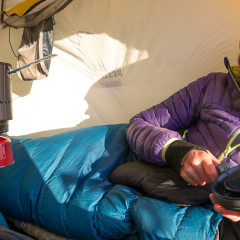
I recently bought the MSR Reactor Hanging Kit for my MSR Reactor Stove System and had an opportunity to test it out. At this point I guess I need to state that MSR recommends that you do not use their Reactor stove or the hanging kit inside the confines of a tent. For legal reasons I understand why they need to do this, it’s the same reason Q-tips needs to warn on their packaging “Do not insert in ear canal” which I’m pretty sure is the actual use of 90% of Q-tips. It is inherently dangerous and hazardous to operate a canister stove inside a tent. Not only could you melt the tent down around you, the stove is also pumping out carbon monoxide which could kill you. You are also making boiling water in an extremely cramped space, which, if knocked over, could severely scald bare skin. In saying all that, if you are smart, and can effectively mitigate those risks there are benefits to hanging a stove inside your tent. For myself I’d be interested in keeping my stove inside my tent when the weather is extremely bad outside, it’s the dead of winter and extremely cold, outside space is limited (camped on a ledge or ridge crest) or all of the above. The benefits of using the stove in this manner, in my opinion, are: Stove runs more efficiently due to less or no wind and by keeping the canister warmer. Less fuel is needed due to the previous benefit. Heat output by the stove is radiating into the tent raising the ambient temperature. Less body heat is being lost by having to operate the stove outside of the tent and outside of your sleeping bag. More appealing to hydrate. We tend to forget the human factor sometimes. I’ve made the bare minimum amount of water before because I wanted to spend more time in my sleeping bag and less time out in the cold. Making water, especially at higher elevations, can be a pain. Usually by the time you have to make water you are already exhausted and just want to lie down and rest. Being able to rest and have your water boiling makes it more appealing to hydrate more. The better hydrated you are the warmer you’ll be, the better you’ll sleep, the more energy you’ll have the next day… etc. If these benefits seem desirable then here is how I recommend mitigating the risks. Light the stove outside of the tent. Canister stoves can flare up when first ignited. You also don’t want to have a few misfires and fill your tent with gas which will combust when...
One Year Ago: Slalok Mountain
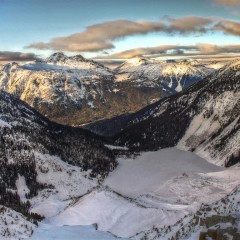
Last December Leigh and I decided to take advantage of a good weather window and make an attempt of the NF of Slalok in the Joffre Group. This was going to be a day trip and it was going to be a long one! The alarm went off at 3:00am and shook me from sleep. I kept thinking it was too early to head out into the cold dark morning, but if we wanted to summit that day and still make it back home in time for a late dinner we need to get out on the road. Hesitantly we got ourselves up, dressed and ready to go. Stepping outside the moon seemed unusually bright, but the fact that we could see the moon would bode well weather-wise for the remainder of the day, so off we went. To save time we decided to skip eating breakfast at home (or making lunch) and go for the traditional Canadian experience and get a drive-thru Timmy’s. Unfortunately as we soon found out they do not serve breakfast before 5:00am, so we ordered bagels for breakfast and bagel sandwiches for lunch(as they didn’t have rolls ready for sandwiches)….mmm this was going to be a bagel filled day. Heading north up the Duffy in the dark the conversation often turned to how tired we felt, how dark it was, how cold it was; but we kept driving. Once pulling into the Joffre Lakes car park, knowing that the estimated temperature for the day was supposed to dip to -20c, we stepped out in the frigid cold and started to layer up. With numbing fingers we both looked at each other and Leigh said “Are you feeling it?” Deep down I thought about the comfort of my warm bed at home and how if we turned around right then I could be back in bed within 2 hours. But I knew I would regret not attempting the peak more than I would regret not getting back into bed, so putting on a brave face I said “Let’s just check it out, we’ll start feeling better once the sun comes up.” The trail to the upper lake was uneventful, just plodding along trying to follow the trail markers in the dark and continually moving forward in hopes of reaching the warmth of the sun. Upon reaching the upper lake we could see some ski tracks headed across the lake tending towards the shore, rather than straight across. It was still early in the season and wanting to save time but still be smart about it, we decided to makes tracks across the lake as close to the shore...
Julbo Tensing: Thoughts on Glacier Glasses
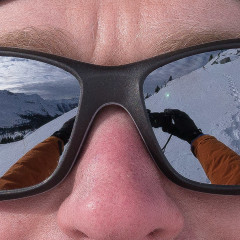
For the past decade I’ve worn Ray-Ban Aviators as my sunglasses of choice. I love them and for the longest time my eyes had never felt strained from sunlight while wearing them. This all changed when I started Mountaineering and hiking across glaciers and snowfields. For those that haven’t been high in the mountains on a sunny day in June in the middle of a glacier it is hard to describe the intensity of the brightness. The snow surface acts like billions of tiny mirrors reflecting the suns light at you from every angle. Without some kind of protection for your eyes you can go “snow blind” very quickly. The higher you go, the thinner the atmosphere which means more damaging UV radiation is hitting your skin. I’ve had my skin badly burnt high in the mountains even on a cloudy, dark day. Add together the increased UV radiation at higher elevations and the reflective nature of snow and ice and you have a cocktail which makes Sunlight just one the many additional dangers a Mountaineer needs to be aware of and protect against. I struggled through however, continuing to use my Aviators in the mountains for the past few years as I could get by without full eye protection, which in hindsight, was pretty stupid of me. My Ray-Bans filtered out most UV radiation hitting my eyes straight on but my eyes would feel strained from glancing rays coming under and through the sides of my glasses. The final straw that made me finally decide to retire my Ray-Bans from Glacier use was when I was climbing Mount Rainier last August. Above 4000m’s on the Ingraham Glacier in the midday sun I was experiencing the strongest UV radiation ever. Even with my Ray-Bans on I could barely let my eyes open a slit to see. After hours of this I had to cover my eyes to try and rest them whenever we’d stop for a break on our descent. I’d spent thousands making sure I had all the necessary equipment to protect my body on this huge mountain but neglected to think about spending less than a hundred bucks to protect my eyes. Once back to civilization I started looking online for Glacier Glasses. Julbo will almost always show up if you do a search yourself as they seem to be a market leader for this specific class of sunglasses. Ultimately, as the title suggests, I chose the Julbo Tensing. It had the right mix of functionality, weight, price (~$50) and aesthetics for my needs. Plus, the name Tensing also sold me a little. It’s an homage to Tenzing Norgay,...
Hurley Silver Mine
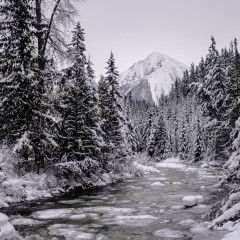
Sometimes it’s nice to tag along on a trip and not really do anything to plan it. It’s too easy nowadays to completely destroy any discovery when exploring a new area by doing research online. Most places will have pictures of everything on the route, 360’ video panoramas, HD Satellite imagery available in Google Earth, with detailed reports describing every step of the way. (I’m aware of the irony of writing this and posting it online). This isn’t necessarily a bad thing, but sometimes it’s nice to discover an area fresh without any previous knowledge of what to expect. So mid last week I received word that a friend wanted to explore the “Hurley Silver Mine” area and potentially summit “Hurley Silver Peak”. I’d remembered reading something about it, and vaguely knew it was off the Duffy Lake Road so I agreed. I’ve never been on a bad hike that started from the Duffy Lake Road. Saturday morning seen four of us heading North, past Whistler, then Pemberton and along the Duffy. We passed the pullouts for all the popular weekend spots for sledders and skiers and they were packed. Why wouldn’t they be, conditions were awesome and the weather was forecast for bluebird skies. I worried that our chosen area would also be overrun by skiers and sledders also. Nearing our parking spot I seen it was empty with only an old pickup parked up the road. My friend, Adrien, mentioned that we had to be dropped off at the parking area and that Ben, the driver, would need to park about a kilometer away as there was rumours that a First Nations man might vandalize our vehicle if we parked nearby. Turns out there used to be a proper, drivable bridge that crosses Cayoosh Creek which runs parallel to the Duffy Lake Road for a while, but it washed out some years back. Since then a new footbridge has been installed, purportedly by this First Nations man who lives on the opposite side of Cayoosh Creek, the side we’d need to cross over to before heading along the Hurley Silver Mine road towards our objective. He has been reported as blocking peoples attempts to cross this bridge. Whether or not these rumours are lore, past tense or true didn’t matter. It was better to err on the side of caution rather than risk a possible confrontation. We unloaded, moved the car a safe distance away, geared up, then quickly scurried across the footbridge and along the road. The footbridge instantly meant we wouldn’t be listening to the obnoxious sound and smell of sleds for the weekend. We...


