
Need Less. Be More.
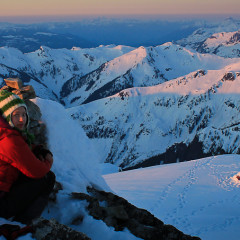
“What are you willing to give up?” That was the response Sonnie Trotter, a professional Rock Climber, gave in reply to the prosaic question from the audience that asked “How can I have a life like yours?” I was sitting in the back row at the ACC Clubhouse in Canmore, AB. Sonnie had just given a demonstration on a recent climb and opened up the floor for questions. When he responded I could tell from the slumping shoulders of the individual who had asked the question that it wasn’t the response he was looking for. Giving up stuff sucks, especially our comforts. But I do agree with Sonnie. If you want to wedge a new way of living into your life then something else is going to have to get shunted out in the process. I say I agree with Sonnie, but I didn’t choose to be this way, it happened rather organically as a result of wanting to need less when camping high in the mountains. The more I climbed and the tighter my shoulders got from carrying heavy and cumbersome overnight packs the more I analyzed the contents of them to reduce weight. I’m not a true Ultralight Backpacking follower, but I do believe an individual should be critical of everything that goes into their pack. I ask “Why do I need this item? Can I replace it with something else? What happens if I don’t bring it?” I got into a rhythm of doing this and over time it became natural. What started to happen though was that the principles from it started to bleed into my everyday life. So, I’ve compiled some advice below on ways in which you can start to “need less”. “Being more” will come naturally as a result. What happens when you need less is that you have more time and money to put towards the things you really want to do. Will it be easy at first, probably not. Will you eventually love doing it, I guarantee it. This list of advice isn’t conclusive and feel free to comment with your own advice. I might revisit the subject in a while if I make additional changes that I think are worth knowing. But anyway, here goes First, you need to understand your needs, then understand which of them can be reduced or removed. If you’re like me you’ll soon realize that many of your “needs” were actually just “wants” all along. The easiest way to start is with consumables. Personal consumables in my life are: Food & Drink, Gas, Toiletries, Electricity, Heating, Other Stuff. Food & Drink: - The number 1 piece of advice I can give everyone...
You will never become anything, and that is your reward
To some that title will be shocking. It wasn’t uttered sarcastically either as the above video illustrates. In my opinion it’s actually a pretty hard task to never become anything in our Society. Every decision we make corrals us into a bracket with a series of parameters that need to be adhered to. Every day we work in a given job we become more and more likely to continue to spend our lives working in that same line of work. Fear of insecurity makes us do it to ourselves. In general we don’t like to feel insecure. However, living right on the cusp of my fears and always feeling a little insecure is where I, personally, have found I grow the most. “Security is mostly a superstition. It does not exist in nature, nor do the children of men as a whole experience it. Avoiding danger is no safer in the long run than outright exposure. Life is either a daring adventure, or nothing.” - Helen Keller This brings me to a thought I’ve been having lately in regards to setting goals for oneself. I’ve tried to put some form to it as every time I bring it up in conversation it is met with much consternation. Expect me to revisit the subject in the future. My thoughts are that Goals are a bad thing. But only a particular type of goal. Let me elaborate. The word “goal” has a pretty broad definition. We’re in a New Year now (gosh is it February already!) and people ask “What are your goals for this year, or, your New Year Resolutions?”. For me I’ve got a series of expectations for myself this year. I’d like to do a sustained technical route on a large mountain. I’d like to lead a multi-pitch rock climb. I’d like to get better at Down Hill MTB. There are a few peaks and hikes that I’d like to visit also. There’s also my endeavor to drop my body weight below 170lbs and run in the Squamish50 23km race as written about here So I have a bunch of goals you could say. But why do I want to achieve them? This is the crucial part. I want to achieve them because I believe I will feel more fulfilled by doing so, that it will help me grow as a person and that reaching these goals will be a source of happiness for me. So, in short, for me Reaching Goals = Fulfillment + Growth + Happiness. One problem with the mentality behind setting some goals for ourselves is that we can potentially imprison ourselves within the parameters of that goal. The further away in...
Into the Wild: the film, book and idea
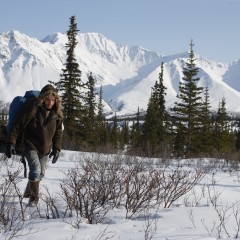
I understood what he was doing, that he had spent four years fulfilling the absurd and tedious duty of graduating from college and now he was emancipated from that world of abstraction, false security, parents, and material excess. ― Jon Krakauer, Into the Wild Will contain spoilers, you’ve been warned. Time changes a person. When I first watched “Into the wild” back in 2007 I was working in IT, playing video games in my spare time and trying to do as much as possible to remain stationary 7 days a week. I had no interest in the great outdoors and couldn’t understand individuals who did. So when I watched the film “Into the wild”, directed by Sean Penn and starring Emile Hirsch, I couldn’t believe that this individual had so selfishly ended his life. He’d ignorantly walked into the wild without training or proper equipment and died when an individual with even a modicum of sense wouldn’t have. It left me slightly angry that this story would even be worth writing about, let alone get turned into a movie. Fast forward to 2010. I moved from Ireland with my wife on a whim to seek out adventure in Canada. I didn’t know what awaited me there, I just needed to do something different. I guess spending most of my time motionless for so many years had left me feeling like my life was also standing still. I discovered the outdoors and embraced it. My perceptions changed steadily, almost, unnoticeably, so in 2012, while looking for a book to take out at the library (yes people still use those) I seen “Into the wild” by Jon Krakauer. Back in 2007, Krakauer was an unknown to me, but now, in 2012 he is someone I know a fair bit about due to our mutual love of mountaineering and high peaks. Truthfully, I hadn’t thought much about the story of Christopher McCandless since 2007. It was only upon seeing the book on the shelf by the same name that the memories of how angry I’d felt about that movie flooded back into my mind. It was like these were the memories of somebody else, somebody I no longer recognized. The person I am now does nothing but dream about the wild and being surrounded by it. I stare over at the hills and peaks that surround the town where I live and wish to go there always. I felt I needed to revisit this story again, to get a fresh perspective on it, so I rented out the book. I read through it pretty fast, which is unusual for me as I can take a year or more to read a short book. I...
Get your nose against it
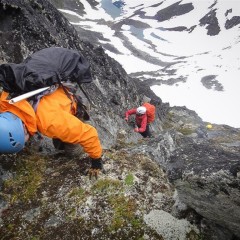
The pleasure of risk is in the control needed to ride it with assurance so that what appears dangerous to the outsider is, to the participant, simply a matter of intelligence, skill, intuition, coordination… in a word, experience. - A.Alvarez I can’t remember when I first heard the maxim: “get your nose against it”, but it stuck. I repeat it as a mantra to myself, primarily in the mountains. Sometimes I’ll be standing at the base of a mountain and the terrain ahead will look steep, exposed, dangerous and complicated. The first few times I encountered situations like this I turned back and quit. Looking up at everything I’d have to deal with to summit this mountain was overwhelming. Mountains can make you feel very small and insignificant if you don’t understand how you need to approach them. The ethos behind getting your nose against it is simple. When you force yourself to stop standing back and touch the mountain or obstacle with your nose you see that it isn’t this large, ominous hulk of a thing, but it’s rocks, and soil and ledges and ramps and snow and ice and before you know it you’ve passed it. It’s a philosophy akin to the idea of “baby steps”. When attempting something, anything, don’t quit or give up before you’ve started because you imagine the goal is too lofty. Just forget about the end result, and keep your nose against it, concentrate solely on the immediate next step. Sure you might have to quit anyway, but let it be when you’re right up against it, touching it. Understand why it is that you need to stop and don’t just assume you aren’t good enough to tackle it. The mountains for me are like a microcosm of all life experiences. You, and everyone else, climb mountains daily, figurative mountains. It’s the literal mountains though that really shine a light into what drives us as humans. We get to see a literal representation of how we deal with our problems and goals day to day and what we need to change to become better. Like with everything though, you need to temper this maxim with some common sense. Sometimes you can evaluate that the terrain ahead is too dangerous from afar, like during avalanche season for example. But, if you take anything from this, have this idea of getting your nose against it always in your head. It will lead you to try new things, meet new people you may have avoided, have new experiences and above all else, make you more competent and rational as you move in the mountains and the wild, which is, after all,...


