
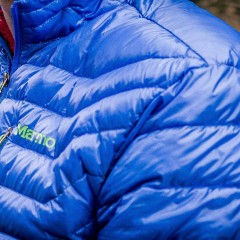
Marmot Quasar Down Jacket Review
Recently I was in the market for a new insulating layer to add to my current layering system. I have a heavy Down Jacket by TNF, which is great for Winter use, but through the Summer and shoulder seasons, or even in the Winter when stopping for only a few minutes for a break, it’s mostly overkill. So for a lighter alternative, I narrowed it down to two choices; The Mountain Hardwear Ghost Whisperer Down Jacket and the Marmot Quasar Down Jacket. Obviously, I went with the latter. Price point ultimately decided it, as, specifications wise, they are pretty similar. You can find the jacket on Amazon: Marmot Men’s Quasar Jacket, Black, Medium. If I’d gone with the Ghost Whisperer I would have been paying an extra $2.60 for every extra gram of weight saved. Not worth it in my opinion. Since getting the jacket it’s been with me on nearly every trip into the mountains. I commented on a few of the noteworthy features in the video above, below I’ll mention a few of the jackets pros and cons that I’ve noticed so far. Pros: Super light, very warm: It almost feels like wearing nothing and I was skeptical as to how warm this would actually keep me. But, the 900 fill down and windproof Pertex fabric works wonders. It’s very warm and insulates excellently. Color: This is subjective, but I love the almost metallic finish to the color. In the Backcountry I purposefully choose garments that will stand out against the natural colors of the environment. This serves two purposes; one, they stand out better in photographs, two, if I ever needed to be found by SAR I want my clothes to make it easier for them. Durable fabric: I was wary about the super thin fabric used but I haven’t had to baby it at all. I’ve stuffed it in my pack with hard objects like snow probes and shovels and it hasn’t damaged it. The fabric also seems resistant to letting the down bleed out. I’ve noticed no bleeding so far. Compact: I could literally ball it up and make it almost fit inside my closed hand. It’s light enough and small enough that there is very little reason for me to ever not have this jacket in my pack. Cons: Fit: It’s long on the torso. I can understand this as being a benefit in some situations but in most it means the hem works its way below the hem of my waterproof hard shell allowing it to get wet. I usually have to keep the hem draw cords pulled tight to stop this from happening....
Crown Mountain: Powder Pushers
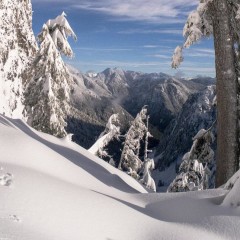
Mid last week we got wind of a planned trip to investigate and possibly climb Crater Couloir on Crown Mountain. It’s been on our radar for a while so we immediately put our names down to go along. Some details changed and due to a few of us needing to be back in the city earlier 4 of us, Spring, Leigh, Dean and Adrien ended up planning to start hiking at 4:30am it meant a 3am wakeup alarm on a Saturday but c’est la vie. We approached via the Grouse Grind trail, a leg burner that stops for most at the Chalet at the top where they check their watches, record their times and never venture further into the backcountry beyond. For us, the Chalet would be our first pitstop. Starting in the dark, and trudging up this trail that turned from soil, to ice, to snow it was a novelty to burst out into the open and be surrounded by the fully lit up Grouse Mountain Resort. We refilled our water bottles in the Chalets restrooms, changed some gear around then headed out on the corduroy groomed trails towards Crown Mountain, where we left the groomed and broken trails behind. We made good time from here and passed Dam Mountain, Little Goat Mountain and then continued down to Crown Pass. As our plan was to do the Crater Couloir we started descending towards the Hanes Creek Valley at this point. About half way down we noticed a rather large and wide runnel that had been formed recently by a slide released from the bluffs above to our left. It was enough of a pause to question whether we should attempt the Couloir at all. Conditions weren’t good and we all knew it would be a heinous snow treadmill up the couloir so we decided to leave it for another day. We decided to attempt the summer scramble route instead. Once we regained Crown Pass we began following the Tree Markers that lead the way along the summer trail. Simple sections that I’m sure are easily bypassed when there isn’t any snow ended up taking considerable amounts of time. An ice layer about a foot or two beneath the snow caused numerous problems in steep sections as the snow on top of it would slide and would also not compress to allow us to make footholds. To add to this, due to the snow, the runouts in quite a few sections of sidehilling were pretty bad. Nevertheless, we pushed on, swimming and plowing through the powder. We gained the final ridge to the summit and decided to don our...
Get your nose against it
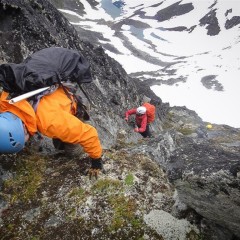
The pleasure of risk is in the control needed to ride it with assurance so that what appears dangerous to the outsider is, to the participant, simply a matter of intelligence, skill, intuition, coordination… in a word, experience. - A.Alvarez I can’t remember when I first heard the maxim: “get your nose against it”, but it stuck. I repeat it as a mantra to myself, primarily in the mountains. Sometimes I’ll be standing at the base of a mountain and the terrain ahead will look steep, exposed, dangerous and complicated. The first few times I encountered situations like this I turned back and quit. Looking up at everything I’d have to deal with to summit this mountain was overwhelming. Mountains can make you feel very small and insignificant if you don’t understand how you need to approach them. The ethos behind getting your nose against it is simple. When you force yourself to stop standing back and touch the mountain or obstacle with your nose you see that it isn’t this large, ominous hulk of a thing, but it’s rocks, and soil and ledges and ramps and snow and ice and before you know it you’ve passed it. It’s a philosophy akin to the idea of “baby steps”. When attempting something, anything, don’t quit or give up before you’ve started because you imagine the goal is too lofty. Just forget about the end result, and keep your nose against it, concentrate solely on the immediate next step. Sure you might have to quit anyway, but let it be when you’re right up against it, touching it. Understand why it is that you need to stop and don’t just assume you aren’t good enough to tackle it. The mountains for me are like a microcosm of all life experiences. You, and everyone else, climb mountains daily, figurative mountains. It’s the literal mountains though that really shine a light into what drives us as humans. We get to see a literal representation of how we deal with our problems and goals day to day and what we need to change to become better. Like with everything though, you need to temper this maxim with some common sense. Sometimes you can evaluate that the terrain ahead is too dangerous from afar, like during avalanche season for example. But, if you take anything from this, have this idea of getting your nose against it always in your head. It will lead you to try new things, meet new people you may have avoided, have new experiences and above all else, make you more competent and rational as you move in the mountains and the wild, which is, after all,...
MSR Reactor Stove Review
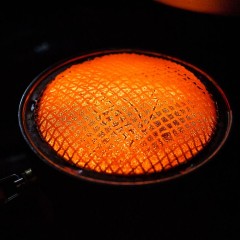
I bought my first backpacking stove around June 2010. That may seem fairly recent but if you backpack frequently through all 4 seasons you learn what works and what doesn’t fast. Every trip is like an extensive field test with peer reviews from the other members in the group. Not only is your equipment being analysed but you are also analysing and reviewing everyone elses equipment. It was in this manner that I came to know about the MSR Reactor Stove. My first stove was the ubiquitous MSR Whisperlite I was recommended to purchase it by an MEC employee here in Vancouver, and I feel it was the best option for someone just starting out with camping and backpacking. It’s not light by any stretch of the imagination, but it’s rugged, durable and it gets the job done through all 4 seasons in any weather conditions. It impressed me enough that I ended up getting my first tent and snowshoes from MSR also. Anyway, getting back to the MSR Reactor Stove. I’d been using my Whisperlite for about a year and a half and was satisfied with it. When hiking with others I’d ask them primarily about the “boil time” on their stoves. It tends to hover between 3 and 5 minutes for the most part for all current stoves. The Whisperlite boils 1 Litre of water in 3.9 minutes so certainly not the best, but what difference does waiting an extra minute make right? That’s when I noticed a friend I backpacked with using the MSR Reactor. We’d get to camp, set up our tents, then start making dinner. I’d sit down and start setting up my white gas fueled Whisperlite. I’d just have it starting to boil the water and look over at my friend and not only was he finished boiling his water, he would also almost be finished eating the meal he’d just rehydrated with the boiled water. I never watched him, as I was too involved with my own setup, so how he managed to finish so fast was confusing. The Reactor only boils around 55 seconds faster than the Whisperlite and in independent test videos I’ve seen this to be true also. So how was he finishing at least 10 minutes or more faster than me? On our next outing, I made the point to watch him as I was also setting up my own stove and pot. Within seconds I understood the difference. He had his stove assembled, lit and boiling water before I’d even taken my stove components out. The Whisperlite requires a fair bit of setting up to get it going....


