
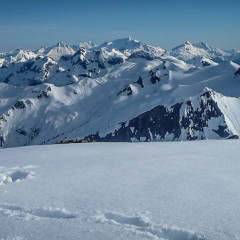
“Great photos aren’t taken, they’re made”
I’ve seen the title of this post, a quote from Ansel Adams, come up a few times when reading about modern photography and it generally holds negative connotations as people assume it refers to excessive post processing and “photoshopping” to change the results in the image. This is not what Ansel was referring to. He was referring to the difference in the eye of someone who is, or hopes to be, a Photographer and an individual who is simply taking a snapshot. Beauty can be seen in all things, seeing and composing the beauty is what separates the snapshot from the photograph. - Matt Hardy For the most part, I’d safely define the vast majority of individuals who own cameras as amateur Photo Journalists, in that they wish to journal the events and moments they experience so they use a camera to effectively do this. A turning point happens when you stop trying to catalog events as they happen and wish to create an artistic representation of what you are seeing. When you start to become an Artistic Photographer. When you stop merely taking a photograph of a scene and start making the photograph before you close the shutter. Don’t shoot what it looks like. Shoot what it feels like - David Alan Harvey For me this has been a gradual process. I largely started out wanting to journal my experiences as they happened. Comparing my folders of digital images now I’m not really taking more images today than I was a few years ago but what I’m photographing has changed immensely. Going back a few years I can see that I would take photos as I moved, usually at eye height and directly at what I was looking at. I’d usually take one photo per view and move on. Now, I’m taking a similar number of photos but the content has been vastly reduced. I’m taking many pictures of a single moment, from different angles and heights, with different apertures, ISO’s and shutter speeds. The gap in time between my photos is no longer documented as I’m not concerned with simply journaling my experience but rather creating my own personal artistic representation of the experience. The difference between “Taking” and “Making” a photo you’d print and hang on your wall is subtle but the results can vary immensely. Making a photo could be as simple as dropping to one knee and using a different aperture rather than taking the photo from a standing height and using the auto setting on the camera. I don’t imagine that I’m an amazing photographer myself, but I make photos that I personally...
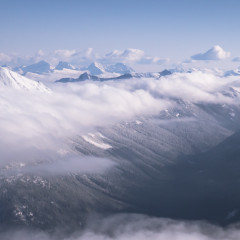
Arc’teryx Cierzo 35 Backpack Review
Size: 0.58kg/20 oz 35L/40L max Activity: Rock Climbing/Ice Climbing/Alpine Climbing See link for full list of features: Arc’teryx Cierzo 35 Daypack - Black Previously the only pack I owned and used was a 55lt Gregory Pack, with all the straps, pockets and loops you would ever need. Although I still love and use this pack, mostly in winter when I want a bit more comfort, it wasn’t always appropriate for light summer trips as it tended to be too heavy and bulky. Last summer we had a 3 day traverse trip planned that would have us bivying and traveling as light as possible, so I knew right then that my good ol’ Gregory pack would need to stay home that trip. I did a bit of research and spoke to a friend who already owned and used a Cierzo 35 and decided that would be the pack for me. This pack is as minimal as it can get while still offering some durability and a small amount of comfort. I have been using this pack for everything from crag climbing, multi-day mountaineering trips, ice climbing and even a 2 day back-country ski trip. Here is what I have found since using it: Pros: 1) Extremely lightweight. When researching this bag I came across this quote: “A designer knows he has achieved perfection not when there is nothing left to add, but when there is nothing left to take away”. ~Antoine de Saint-Exupery~ This really sums it all up for me. There is nothing excessive on this bag. It “does exactly what it says on the tin”. It is described as being compact and nearly weightless, and I would have to agree. 2) Sits above your harness. Because of it’s compact & compressible design(no inner frame) you can push the pack to sit above your harness comfortably. This makes it easy to climb in and because it is not sitting off or your body due to a frame, it becomes part of you and your movement. 3) With 2 ice axe loops and velcro axe keepers it was designed with the climber in mind. There is also micro daisy chains sewn to the front of the pack which makes for easy attachment of other items with carabiners or add on velcro straps. 4) Durable. I am not overly rough with my gear, but when I am out in the mountains my comfort and safety always comes before thinking about getting a tear or stain on my bag. With that in mind I have found the Cierzo to be very durable for what I have subjected it to. 5) For a 35lt bag it can store alot! This...
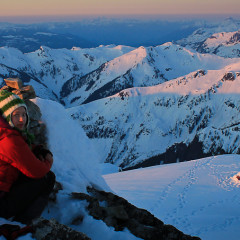
Need Less. Be More.
“What are you willing to give up?” That was the response Sonnie Trotter, a professional Rock Climber, gave in reply to the prosaic question from the audience that asked “How can I have a life like yours?” I was sitting in the back row at the ACC Clubhouse in Canmore, AB. Sonnie had just given a demonstration on a recent climb and opened up the floor for questions. When he responded I could tell from the slumping shoulders of the individual who had asked the question that it wasn’t the response he was looking for. Giving up stuff sucks, especially our comforts. But I do agree with Sonnie. If you want to wedge a new way of living into your life then something else is going to have to get shunted out in the process. I say I agree with Sonnie, but I didn’t choose to be this way, it happened rather organically as a result of wanting to need less when camping high in the mountains. The more I climbed and the tighter my shoulders got from carrying heavy and cumbersome overnight packs the more I analyzed the contents of them to reduce weight. I’m not a true Ultralight Backpacking follower, but I do believe an individual should be critical of everything that goes into their pack. I ask “Why do I need this item? Can I replace it with something else? What happens if I don’t bring it?” I got into a rhythm of doing this and over time it became natural. What started to happen though was that the principles from it started to bleed into my everyday life. So, I’ve compiled some advice below on ways in which you can start to “need less”. “Being more” will come naturally as a result. What happens when you need less is that you have more time and money to put towards the things you really want to do. Will it be easy at first, probably not. Will you eventually love doing it, I guarantee it. This list of advice isn’t conclusive and feel free to comment with your own advice. I might revisit the subject in a while if I make additional changes that I think are worth knowing. But anyway, here goes First, you need to understand your needs, then understand which of them can be reduced or removed. If you’re like me you’ll soon realize that many of your “needs” were actually just “wants” all along. The easiest way to start is with consumables. Personal consumables in my life are: Food & Drink, Gas, Toiletries, Electricity, Heating, Other Stuff. Food & Drink: - The number 1 piece of advice I can give everyone...
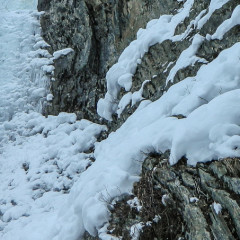
Ice Climbing, Canmore
Swing like you screw, kick like you poo. “I don’t screw like that” a girl replied cheekily from the back row of our Ice Climbing group. Our instructor, Carl, paused a moment, cracked a wry smile in response and moved on: “When you swing your Ice Tools get your hips in against the ice, legs extended and shoulders out, like you screw. When you want to kick, hang off your highest tool and get your butt out, like you’re going to poo and look at where you want your feet to go” We were on our second day of Ice Climbing instruction with Yamnuska Mountain Adventures near Canmore, Alberta. The previous day they’d given us an intro to Ice Climbing at the climbs Irish Mist and The Water Hole, today we were at Kings Creek to hone our technique further on some single pitch Ice. The snow gods had finally answered the pleas from Skiers all over the Rockies and on this day it was dumping snow after a rather long drought in these parts. Anything we put down on the ground for a few moments was soon buried under fluffy white powder. I imagined it might make for a rather miserable day of climbing Ice but it turned out to be one of the best. Kings Creek lies at the bottom of a gorge with steep rock walls on either side. As snow built up above eventually it would fall off branches, boulders and slopes when they could no longer hold the weight of it. It would cascade down, get funneled into gullies, gain speed, bring other loose snow with it and eventually reach the bottom where we were climbing. This made for an almost ethereal experience while climbing ice, which isn’t exactly the most normal activity to begin with. Snow cover Belaying in Kings Creek Kings Creek Climb As we climbed, periodically, these sluffs of snow would hit us in waves. It was like being suddenly shaken up inside a snow globe. You could only brace against the ice and hope your belayer hadn’t been buried below. As I finished climbing another line and shouted “Take!” to my belayer, I clipped my ice tools into my harness and lowered my hands to my sides. My hands started to ache, ache badly (In ice climbing this is affectionately known as the Hot Aches or the Screaming Barfies). I braced against the pain and resolved to stop over gripping my Ice Tools next time. I looked down and shouted “Lower” to my belayer. At that moment I could see a snow sluff from my vantage point picking up mass and momentum above and barrelling down....
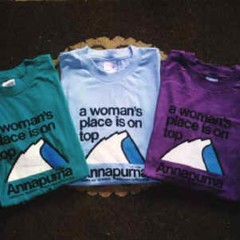
A Woman’s Place Is On Top
The opening line of Arlene Blum’s book Annapurna: A Woman’s Place reads “You never conquer a mountain. You stand on the summit a few moments, then the wind blows your footprints away.” It’s a wonderful statement because it does not encompass gender or ability. There is nothing to be conquered, only moments to be experienced; it doesn’t matter if you are a man or a woman. This book shares the experiences of a group of women set out to push the limits that society, at that time, had placed upon women. High altitude mountaineering, still in it’s relative infancy, was having it’s limits pushed by some of the greatest climbers that history had ever seen, all of whom were men. Arlene Blum tried to be part of this exclusive group, at times successful and sometimes being defeated by traditional mindsets; she persevered to attain her dream and hold onto the hope that women could make their mark in this elite club. nothing to be conquered, only moments to be experienced After reading many books written by men it is so refreshing to read a mountaineering adventure from a woman’s perspective. I have read a lot of excellent mountaineering books written by men such as Ed Viesturs, Chris Bonnington, Jim Wickwire, David Roberts, Jon Krakauer, Reinhold Messner and found them very inspiring and well written. However, as a woman I always felt the tales told from the perspective of a man always lent towards the logistic side of the climbs, the technical aspect and the testosterone driven need for success. An estrogen driven adventure is very different indeed. It lends more towards the feelings and the sensitivity felt towards other peoples feelings. So many times throughout the book I could relate to the emotions being expressed, despite not being able to share the exact experience. Told from a woman’s perspective made it very relatable rather than just enjoying the book for it’s narrative quality and adventure. Arlene Blum told it from a very real perspective. I didn’t feel like moments in the book were ever skimmed over or not fully explored even though there were negative moments and feelings of absolute despair. There seemed to be a constant internal struggle within each of the women to deal with the fact that each of them was a woman climber. A constant struggle with wondering if they were fast enough, strong enough and good enough to be part of such a momentous and incredibly difficult challenge. feelings of absolute despair At one moment in the book,Joan who was in charge of calculating the rationing of the food was having difficulty doing the calculations, Arlene says “ …arithmetic is...


