
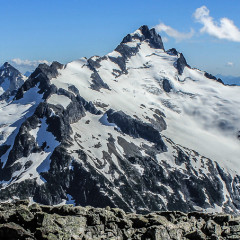
Ossa Mountain
For detailed information about this scramble see: Scrambles in SW BC by Matt Gunn On the 26th of October 2010, myself and a hiking buddy, Matt B. attempted Ossa Mountain in a day. We failed. I was ~30lbs heavier back then with well over 100,000 less feet of elevation gained on my legs. I think Matt could have done it, but there were no views. Anyone who has hiked with Matt will know, he loses motivation quick when there are no views. Just getting to the base of Ossa and then back to the car took us over 14hrs. Ossa Mountain is usually attempted over two days due to the long approach and large amount of elevation gain. It has been done in a day before, but generally by people a lot fitter than I was. Well fortuitously, on the 27th of August, 2011, myself and Matt would both finally summit Ossa. Albeit separately and unaware of each others plans. He would head out to bivy overnight on the summit. I headed out earlier with my hiking partner, Spring, to prove to myself that I was now fit enough to tackle a big day like this in the mountains. At around 5:20am myself and Spring headed out for the Trail Head after grabbing breakfast to go at Tim Hortons. After parking and gearing up we were on the trail shortly after 6am. We moved briskly without stopping, although, I think whenever you hike with others your speed naturally slows. At times I felt like jogging, but I ended up getting too far ahead of Spring, at times Spring would move faster than me but end up having to stop so that I could catch up. We made it to the Sigurd Creek crossing in under 3hrs, then the moraine camp in under 4hrs where we had our first snack and got a look up at Ossa towering above us. The Bugs. Were. MENTAL. Mostly black flies, which don’t seem to bite until they’ve been on you for a few seconds, but they have a propensity to fly right into your ears, eyes, mouth and nose. Every time we’d hear each other coughing on a mouthful of black flies the other would say “remember its just protein” From there we angled up towards the trio of lakes. I didn’t angle up fast enough and we ended up close to a waterfall below the lower lake. I just cut straight up which required some scrambling to get up to the lake. At the highest lake we stopped and filtered some water and made a mental note to go for a swim...
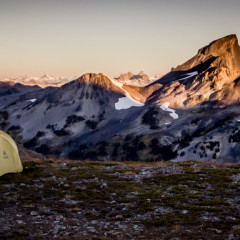
Our first tent: The MSR Mutha Hubba
Back in mid 2010 myself and my wife knew we needed to bite the bullet and start buying all our camping and hiking gear. We’d recently moved to BC, Canada from Ireland and knew that we wanted to start exploring the mountains as soon as possible. The problem was we knew nobody and didn’t know anything about how to properly hike or camp in the backcountry. All our shirts were cotton, all our pants were denim, our shoes were bought for how they looked rather than how they functioned. We had never had reason to ever utter the words “Ice Axe”, “Crampon” or “Gaiter”. Walking into the popular Outdoor Recreation store, Mountain Equipment Coop, in Vancouver we were overwhelmed with how much stuff there was to choose from. We wandered around for close to 4 hours just reading labels, trying stuff on, trying to understand why we’d need one feature over another. Eventually we asked for help from an Employee. He was experienced in hiking and backpacking and guided us for over 2 hours around the store picking out everything from boots, to medkits, to finally a tent. He recommended the MSR Mutha Hubba. We took his advice, and with that we owned our very first tent. It came with us on every overnight trip we took for the longest time. As we grew in our understanding of how to be better hikers and campers our level of appreciation for this tent grew also. It’s simple and quick to set up, has a lot of space inside (you could fit 4 people in a pinch head to toe) and loads of storage in the side pockets. The dual vestibules are nice, especially on snow as you can dig one out and use it as your porch and then use the other one as your kitchen. It’s rated as 3-season only but we’ve comfortably used it through all 4-seasons. Eventually, as we got more comfortable with camping we started to move more towards sleeping in snow pits, under a tarp in a bivy sack, or a much lighter, but cramped winter tent. The Mutha Hubba still gets used occasionally, when we are car camping or when we want to sleep 3 people, but it sees a lot less use now. Every time we take it out though and have reason to use it, we look forward to it. So many memories are stored within those nylon walls, so many amazing views woken up to and perilous nights survived. It was and is an awesome tent. Buy (Canada): MSR MUTHA HUBBA HP 3 PERSON TENT Buy (USA): MSR Mutha Hubba Tent ...
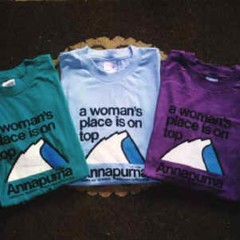
A Woman’s Place Is On Top
The opening line of Arlene Blum’s book Annapurna: A Woman’s Place reads “You never conquer a mountain. You stand on the summit a few moments, then the wind blows your footprints away.” It’s a wonderful statement because it does not encompass gender or ability. There is nothing to be conquered, only moments to be experienced; it doesn’t matter if you are a man or a woman. This book shares the experiences of a group of women set out to push the limits that society, at that time, had placed upon women. High altitude mountaineering, still in it’s relative infancy, was having it’s limits pushed by some of the greatest climbers that history had ever seen, all of whom were men. Arlene Blum tried to be part of this exclusive group, at times successful and sometimes being defeated by traditional mindsets; she persevered to attain her dream and hold onto the hope that women could make their mark in this elite club. nothing to be conquered, only moments to be experienced After reading many books written by men it is so refreshing to read a mountaineering adventure from a woman’s perspective. I have read a lot of excellent mountaineering books written by men such as Ed Viesturs, Chris Bonnington, Jim Wickwire, David Roberts, Jon Krakauer, Reinhold Messner and found them very inspiring and well written. However, as a woman I always felt the tales told from the perspective of a man always lent towards the logistic side of the climbs, the technical aspect and the testosterone driven need for success. An estrogen driven adventure is very different indeed. It lends more towards the feelings and the sensitivity felt towards other peoples feelings. So many times throughout the book I could relate to the emotions being expressed, despite not being able to share the exact experience. Told from a woman’s perspective made it very relatable rather than just enjoying the book for it’s narrative quality and adventure. Arlene Blum told it from a very real perspective. I didn’t feel like moments in the book were ever skimmed over or not fully explored even though there were negative moments and feelings of absolute despair. There seemed to be a constant internal struggle within each of the women to deal with the fact that each of them was a woman climber. A constant struggle with wondering if they were fast enough, strong enough and good enough to be part of such a momentous and incredibly difficult challenge. feelings of absolute despair At one moment in the book,Joan who was in charge of calculating the rationing of the food was having difficulty doing the calculations, Arlene says “ …arithmetic is...
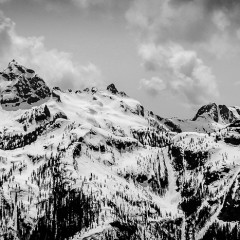
Sky Pilot: Why I Climb
Back in August 2011 I reached the summit of a little peak that sits only a handful of kilometers away from where I live. In a lot of ways this peak, outside of the scrambling and mountaineering community in and around the Southern Coast Mountains of BC, is largely unknown by most individuals. It was unknown to me also until one day I was flicking through the pages of my recently bought copy of Matt Gunns “Scrambles in Southwest British Columbia” in mid 2010. The name “Sky Pilot” instantly stood out. It’s a great name for a Mountain in my opinion and instantly gave the peak a mystique that drew me to want to climb it some day. In many ways climbing Mountains for me is an endeavour to get further away from the comfort and ennui of postmodernity at sea level. The closer I get to the sky above me, the less the trappings of modern life apply, the greater the viscerality of experience. To stand atop this Sky Pilot became a singular focus for me. At the time of discovering this Mountain I could barely hike for 3 sustained hours at sea level. I’d never carried an overnight pack on my back and the word “scrambling” was a manner in which I’d prepare eggs on a Saturday morning, not the homonym for a method to progress over rocky terrain. I knew I had a long way to go before I could hope to safely and enjoyably climb this mountain. An entire year went by. I hiked often and began scrambling to the tops of many peaks in the Ranges close to where I live. But, when I’d stand atop those summits, I’d always scan for the familiar shape of Sky Pilot on the horizon and imagine I was there instead. It is an odd compulsion to be consumed with thoughts about a jutting protrusion of rock and ice. I have spent many an hour trying to understand why some mountains can capture my attention so entirely while others, of no lesser height, difficulty or prowess go unnoticed. Certain mountains get imbued with a personality. I think most people that climb mountains regularly anthropomorphise them a little. They sit like foreboding giants with their shoulders curled away from us. We spend time to get to know their moods, when it seems these Ogres might allow us to reach their summit, and then, as we ascend, gain an intimate understanding about the mountain. Some are not ready to let their guard down and we must retreat, while others welcome us to their top freely. I wanted to get to...
MSR Reactor Hanging Kit: Thoughts on stoves in tents
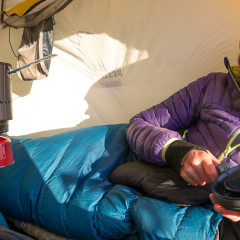
I recently bought the MSR Reactor Hanging Kit for my MSR Reactor Stove System and had an opportunity to test it out. At this point I guess I need to state that MSR recommends that you do not use their Reactor stove or the hanging kit inside the confines of a tent. For legal reasons I understand why they need to do this, it’s the same reason Q-tips needs to warn on their packaging “Do not insert in ear canal” which I’m pretty sure is the actual use of 90% of Q-tips. It is inherently dangerous and hazardous to operate a canister stove inside a tent. Not only could you melt the tent down around you, the stove is also pumping out carbon monoxide which could kill you. You are also making boiling water in an extremely cramped space, which, if knocked over, could severely scald bare skin. In saying all that, if you are smart, and can effectively mitigate those risks there are benefits to hanging a stove inside your tent. For myself I’d be interested in keeping my stove inside my tent when the weather is extremely bad outside, it’s the dead of winter and extremely cold, outside space is limited (camped on a ledge or ridge crest) or all of the above. The benefits of using the stove in this manner, in my opinion, are: Stove runs more efficiently due to less or no wind and by keeping the canister warmer. Less fuel is needed due to the previous benefit. Heat output by the stove is radiating into the tent raising the ambient temperature. Less body heat is being lost by having to operate the stove outside of the tent and outside of your sleeping bag. More appealing to hydrate. We tend to forget the human factor sometimes. I’ve made the bare minimum amount of water before because I wanted to spend more time in my sleeping bag and less time out in the cold. Making water, especially at higher elevations, can be a pain. Usually by the time you have to make water you are already exhausted and just want to lie down and rest. Being able to rest and have your water boiling makes it more appealing to hydrate more. The better hydrated you are the warmer you’ll be, the better you’ll sleep, the more energy you’ll have the next day… etc. If these benefits seem desirable then here is how I recommend mitigating the risks. Light the stove outside of the tent. Canister stoves can flare up when first ignited. You also don’t want to have a few misfires and fill your tent with gas which will combust when...


