
Skins, Skis and Aching Knees
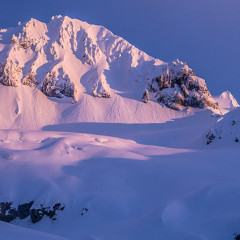
“I’m concentrating on Ice Climbing this Winter, not Skiing” I foolishly uttered those words to myself last Fall believing I would hold fast in my convictions. I truly believe that if you want to get good at something, not just passably capable, you need to pick one pursuit per season. I’ve consistently broken my own rule in this regard. I’m like that dog in the film “UP” that has all the intentions in the world of doing one thing only, until SQUIRREL! I see a SQUIRREL! Coming into Winter last year I wanted to work solely on my Ice Climbing. It was all going well for a while, we took a 5 day ice climbing course in Canmore, Alberta and we tried to go Ice Climbing near Lillooet, BC for a few weekends but the shiny new skis of my friends kept glinting in the corner of my eyes. You see, when I’d chosen to focus on Ice Climbing, my circle of friends had not received the memo. They’d all chosen to focus on learning to backcountry ski. I staved off looking at that Squirrel for a few trips, whilst I wallowed through the powder in my démodé snowshoes. But eventually I couldn’t take it any more. I caved. MEC, our outdoor gear mecca, was clearing out of all their Ski gear for their Spring stock and had slashed their prices. Myself and my other half went in and bought everything we needed; skis, skins, boots and bindings. We already had ski poles and avalanche gear but still, it was a big chunk of change to get going. After the dust settled and we had our newly acquired Alpine Touring Ski setup laid out in our spare bedroom cum walk-in-gear-closet we wondered “now what?” Our friends, who had been touring on their skis all winter, invited us on an overnight trip to attempt a couloir on the East face of Atwell Peak. We wouldn’t be skiing this gully, only skinning up to it and then boot packing our way up to the summit. Nevertheless, just getting to the campsite below the base of Atwell, ~32 kms return with ~2000m’s of elevation gain, would be a big undertaking, seeing as this would be our first time in the backcountry on touring skis. We were apprehensive but I knew that the first half of the route is a common trail for beginner backcountry skiers, leading to the Elfin Lakes Hut. If we felt like we were way out of our depth by the hut we could always temper our plans, stay at the Hut for the night and spend the next day practicing our backcountry...
Arc’teryx Cierzo 35 Backpack Review
Size: 0.58kg/20 oz 35L/40L max Activity: Rock Climbing/Ice Climbing/Alpine Climbing See link for full list of features: Arc’teryx Cierzo 35 Daypack - Black Previously the only pack I owned and used was a 55lt Gregory Pack, with all the straps, pockets and loops you would ever need. Although I still love and use this pack, mostly in winter when I want a bit more comfort, it wasn’t always appropriate for light summer trips as it tended to be too heavy and bulky. Last summer we had a 3 day traverse trip planned that would have us bivying and traveling as light as possible, so I knew right then that my good ol’ Gregory pack would need to stay home that trip. I did a bit of research and spoke to a friend who already owned and used a Cierzo 35 and decided that would be the pack for me. This pack is as minimal as it can get while still offering some durability and a small amount of comfort. I have been using this pack for everything from crag climbing, multi-day mountaineering trips, ice climbing and even a 2 day back-country ski trip. Here is what I have found since using it: Pros: 1) Extremely lightweight. When researching this bag I came across this quote: “A designer knows he has achieved perfection not when there is nothing left to add, but when there is nothing left to take away”. ~Antoine de Saint-Exupery~ This really sums it all up for me. There is nothing excessive on this bag. It “does exactly what it says on the tin”. It is described as being compact and nearly weightless, and I would have to agree. 2) Sits above your harness. Because of it’s compact & compressible design(no inner frame) you can push the pack to sit above your harness comfortably. This makes it easy to climb in and because it is not sitting off or your body due to a frame, it becomes part of you and your movement. 3) With 2 ice axe loops and velcro axe keepers it was designed with the climber in mind. There is also micro daisy chains sewn to the front of the pack which makes for easy attachment of other items with carabiners or add on velcro straps. 4) Durable. I am not overly rough with my gear, but when I am out in the mountains my comfort and safety always comes before thinking about getting a tear or stain on my bag. With that in mind I have found the Cierzo to be very durable for what I have subjected it to. 5) For a 35lt bag it can store alot! This...
One Year Ago: Slalok Mountain
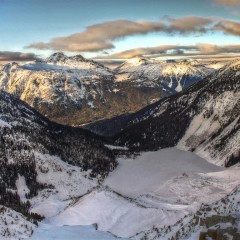
Last December Leigh and I decided to take advantage of a good weather window and make an attempt of the NF of Slalok in the Joffre Group. This was going to be a day trip and it was going to be a long one! The alarm went off at 3:00am and shook me from sleep. I kept thinking it was too early to head out into the cold dark morning, but if we wanted to summit that day and still make it back home in time for a late dinner we need to get out on the road. Hesitantly we got ourselves up, dressed and ready to go. Stepping outside the moon seemed unusually bright, but the fact that we could see the moon would bode well weather-wise for the remainder of the day, so off we went. To save time we decided to skip eating breakfast at home (or making lunch) and go for the traditional Canadian experience and get a drive-thru Timmy’s. Unfortunately as we soon found out they do not serve breakfast before 5:00am, so we ordered bagels for breakfast and bagel sandwiches for lunch(as they didn’t have rolls ready for sandwiches)….mmm this was going to be a bagel filled day. Heading north up the Duffy in the dark the conversation often turned to how tired we felt, how dark it was, how cold it was; but we kept driving. Once pulling into the Joffre Lakes car park, knowing that the estimated temperature for the day was supposed to dip to -20c, we stepped out in the frigid cold and started to layer up. With numbing fingers we both looked at each other and Leigh said “Are you feeling it?” Deep down I thought about the comfort of my warm bed at home and how if we turned around right then I could be back in bed within 2 hours. But I knew I would regret not attempting the peak more than I would regret not getting back into bed, so putting on a brave face I said “Let’s just check it out, we’ll start feeling better once the sun comes up.” The trail to the upper lake was uneventful, just plodding along trying to follow the trail markers in the dark and continually moving forward in hopes of reaching the warmth of the sun. Upon reaching the upper lake we could see some ski tracks headed across the lake tending towards the shore, rather than straight across. It was still early in the season and wanting to save time but still be smart about it, we decided to makes tracks across the lake as close to the shore...
Julbo Tensing: Thoughts on Glacier Glasses
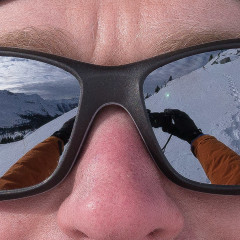
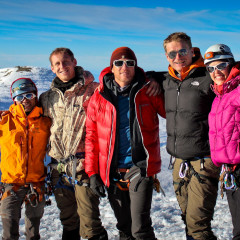
For the past decade I’ve worn Ray-Ban Aviators as my sunglasses of choice. I love them and for the longest time my eyes had never felt strained from sunlight while wearing them. This all changed when I started Mountaineering and hiking across glaciers and snowfields. For those that haven’t been high in the mountains on a sunny day in June in the middle of a glacier it is hard to describe the intensity of the brightness. The snow surface acts like billions of tiny mirrors reflecting the suns light at you from every angle. Without some kind of protection for your eyes you can go “snow blind” very quickly. The higher you go, the thinner the atmosphere which means more damaging UV radiation is hitting your skin. I’ve had my skin badly burnt high in the mountains even on a cloudy, dark day. Add together the increased UV radiation at higher elevations and the reflective nature of snow and ice and you have a cocktail which makes Sunlight just one the many additional dangers a Mountaineer needs to be aware of and protect against. I struggled through however, continuing to use my Aviators in the mountains for the past few years as I could get by without full eye protection, which in hindsight, was pretty stupid of me. My Ray-Bans filtered out most UV radiation hitting my eyes straight on but my eyes would feel strained from glancing rays coming under and through the sides of my glasses. The final straw that made me finally decide to retire my Ray-Bans from Glacier use was when I was climbing Mount Rainier last August. Above 4000m’s on the Ingraham Glacier in the midday sun I was experiencing the strongest UV radiation ever. Even with my Ray-Bans on I could barely let my eyes open a slit to see. After hours of this I had to cover my eyes to try and rest them whenever we’d stop for a break on our descent. I’d spent thousands making sure I had all the necessary equipment to protect my body on this huge mountain but neglected to think about spending less than a hundred bucks to protect my eyes. Once back to civilization I started looking online for Glacier Glasses. Julbo will almost always show up if you do a search yourself as they seem to be a market leader for this specific class of sunglasses. Ultimately, as the title suggests, I chose the Julbo Tensing. It had the right mix of functionality, weight, price (~$50) and aesthetics for my needs. Plus, the name Tensing also sold me a little. It’s an homage to Tenzing Norgay,...
Mt. Rainier
The highest point I had been too before I attempted Mt.Rainier was the summit of Wedge Mountain at 2892m’s, in Garibaldi Provincial Park, B.C., and I remember feeling a keen sense of achievement at having scaled that height. Just knowing that it was the highest summit in the park made it feel like more of an achievement for me, like I had conquered some invisible force, a force that as you reach higher becomes more and more oppressive. Rainier, which stands at just over 4300m’s (14,411ft), was now going to be the tallest mountain I had climbed to date. Despite the many mountaineering trips I had taken in the last few years, the trip to Mt. Rainier felt like something outside of the scope of anything I had known. This was a big mountain and it felt like it deserved a deep respect of it’s own. “….the most luxuriant and the most extravagantly beautiful of all the alpine gardens I ever beheld in all my mountain-top wanderings.” - John Muir As I stood at the Paradise visitor centre looking up at Mt. Rainier on that hot August afternoon, I couldn’t help thinking of how close it seemed. It looked no farther than a stone’s throw away. Rainier just stood there in all it’s glory, streaks of grey rock showing through the late summer snow, deep crevasses gouging the glacier that tumbled down within my view, brightly colored wild flowers dotting the grassy meadows in the foreground. Standing alone in all it’s immensity with no concern for the tiny creatures standing below looking on in awe; standing there thinking that we could somehow conquer this mass of stone and ice. But as usual the mountain doesn’t care that we are there or that we care to struggle and gasp our way up it’s flanks. It is just there, and it was in my own mind that I felt this sense of the mountains willingness to accept us, allowing us to pass and giving me the opportunity to test myself. I remember looking at the winding path that made it’s way in the direction of Camp Muir, comparing it to previous hikes in my mind, thinking it wouldn’t take long at all. The mountain after all looked so close, like a super-imposed image on a screen, but no matter how long I walked that image remained the same distance away. My sense of scale was becoming more and more obscured. At that moment I remembered a quote I had seen in an outdoor store earlier that year regarding the Himalaya, it said “everything is so much bigger and so much farther away than you can imagine”....


