
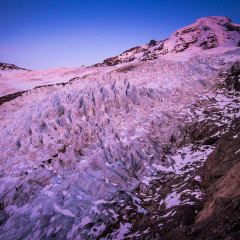
Mount Baker: Ice Climbing
“Did you see the BCMC call out for a trip to the Mt Baker seracs to do some ice climbing? Do you want to sign up?” This was the question I received in a text from Leigh one morning in October. I texted back within seconds saying “Anniversary at Baker!” It just so happened that the Thursday before the trip we would see our 8th year wedding anniversary come and go. This seemed like the perfect way to see in another year of adventure together. We signed up for the trip and started dreaming about climbing ice again. The only type of ice that Leigh and I have climbed before has been waterfall ice, some in the Rockies and some in the Coastal Range, so climbing glacier ice was going to be a new experience for us and it was going to take some time to knock the rust off of our recently acquired ice climbing skills. We set up top-ropes at the first wall of ice we could walk up to on the glacier. These first climbs proved to be more difficult than anticipated, and everyone, albeit 1 or 2, had to shout “take” more than once on their way up. There were several bulges and overhangs to contend with and the density of this ice was proving to be very hard and made for some very ginger tool placements, as no crampon or ice pick was really sinking in. All part of the learning process and also part of the beauty of ice climbing, no two walls of ice are ever the same. Once we had our fill of these climbs we decided to make our way over to an area where 2 from our group set up a few more ropes. We had to weave around gaping crevasses, jump over cracks in the ice and down-climb some sections just to get to the climbing area. It was unnerving but so much fun at the same time. It was really starting to feel like we were on another planet with such an other-worldly almost eery feeling. The only sounds apart from the odd shout of “on belay” or “climb on” was the groaning and cracking of the glacier. I walked the final narrow ice bridge towards the crevasse where the top-ropes were set up to see that you had to rappel into the hole if you wanted to climb. I felt a reluctance at first, as my first instinct is to always avoid being inside a crevasse, but I had to find a way to push through it and I joined Leigh and our friend Scott down below. Did someone say...
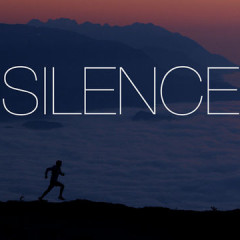
What gets us Stoked, VIII
Some of the videos we watched this week that we hope you will also. We especially like the piece featuring Adam Campbell called “Silence”. It was filmed close to our home on Brohm Ridge. A pretty special place to go running. Let us know if you’ve watched something this week that inspired you. Mixed Climbing: Sky Running: Living Life: Mountaineering: Trail...
What gets us Stoked, VI
Something tells us we’re going to regret using Roman Numerals for these video posts. “What’s the symbol for 6 again?” Anyway, here’s a cross section of what we’ve watched this week. We’ll definitely need some stoke for this weekend as it will involve Crampons, Ice Tools, no Ice and wet rock. Dry Tooling baby! Mountain Biking: Climbing: Mountaineering: Skiing: ...
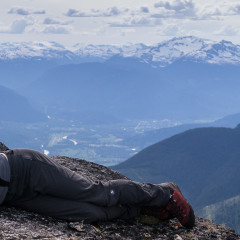
Tszil Mountain & Mount Taylor: Photo Essay
“Halo, Halo! At a place called Vertigo!” It seemed apropos that being a U2 fan (comment if you got the reference), being high in the mountains and being completely awestruck by the Sun Halo above me that that variation on those lyrics would come into my head as we ascended an airy, narrow moraine to gain a col. between Tszil Mountain and Mount Taylor. Myself, Spring and Ben had plans to explore some peaks in Joffre Lakes Provincial Park and did just that. If conditions were in we planned to also visit Slalok Mountain as well. Ultimately we ascended only the peaks mentioned in the title of this post but will be back to visit Slalok Mountain under drier conditions. This Park is justifiable so. It’s simply amazing and photos and words cannot do it enough justice. However, if I had to choose, photos do a better job than words in my opinion so I’ll let them do the talking. Have you been to Joffre Lakes? Which picture below is your...
Wedge Mountain: North East Arête
On the first weekend in June, 2013 myself, Spring and our friend Ben decided to try a classic Alpine Mountaineering route in Garibaldi Provincial Park called the North East Arête of Wedge Mountain. Myself and Spring had been to this peak before. Two years previously we had reached the summit of Wedge Mountain as a day trip that took us over 15 hours and required thousands of meters of elevation change. Back then we were still pretty green in our Mountaineering abilities so we didn’t even consider the NE Arête as an option to reach the summit so we took the West Ridge, which is considerably less classic as an ascent route due to it being a long, tedious slope of loose scree, talus and general Type 3 fun. Still, on that trip I took the following picture, possibly my favorite picture of all time so Wedge Mountain has a special place in my heart. We planned a revisit with Ben to attempt a more aesthetic route, but this time we’d do it in a more Mountaineering style by splitting the trip over 2 days, and getting an early alpine start from a base camp near the foot of the peak. We set up our tent at Wedgemount Lake and introduced ourselves to some other parties staying in the modest shelter nearby who had intentions to climb the North East Arête also the following morning. We had dinner lazily and turned in early for the coming alpine start which would have us up and ready well before sunrise. The next morning we awoke, and after getting some calories and caffeine into us we were off. We moved briskly but immediately I noticed something different to this start than other alpine starts I had done before. It was no later than 4am but it was warm out and the snow underfoot did not have the satisfying crunch that I expected. Usually, snow in the alpine in the Spring softens up through the day and then hardens up again overnight as the temperatures drop. This snow had clearly not gone through this cycle as there had been no winds overnight and the freezing level had stayed high. It was a bad sign about conditions we might face higher on the mountain but we pressed on. There was still the chance that conditions higher up on the mountain might improve as it was less sheltered from the wind and more likely to be within the freezing level. Shortly thereafter we met up with the other parties that had started earlier than us as we roped up for glacier travel. We would need...


