
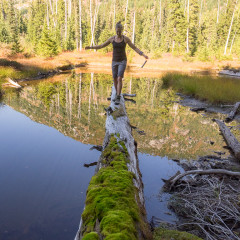
LifeStraw Review
Adventuring in the mountains, running on the trails or travelling to new countries has something in common - the need for clean pure drinking water. Hydration is often something we can take for granted in the western world where we have access to clean drinking water from practically every faucet. However, if you are someone who frequents wild places whether in the mountains, forests or travels to countries where clean water is not readily accessible, the need for clean drinking water becomes a main focus…boiling, filtering or buying bottled water is a must. This often takes considerable time and effort. What if there was a quick and easy way to filter water on the go? We have recently had the opportunity to test out the Vestergaard LifeStraw & LifeStraw Go from Eartheasy. It has changed the way we think about filtering water and significantly increased our ability to hydrate on the go no matter where we are. LifeStraw A convenient straw style filter that is easy to pack and designed for use on the go. Stats: 2 ounces. 9” long x 1” diameter. BPA free, contains no chemicals. Filters out 99.9999% of waterborne bacteria, including E.coli and 99.9% of waterborne protozoa, including Giardia & Cryptosporidium. It also reduces turbidity, filtering down to 0.2 microns, which makes it great for glacial melt water. Filters up to 1000 liters. No aftertaste. Lifestraw does not use iodine. Perfect for an emergency preparedness kit. Due to it’s small compact size we have brought this with us hiking and it is always in our trail running packs. When we know we will be passing by a small stream, tarn or lake we take the opportunity to drink right then and there. It saves us having to stop and re-filter or boil water to fill our water bladders. Being able to pull out the Lifestraw at any given moment to take a few sips of water from a natural water source, safely, without a second thought, is definitely reassuring. Pros: Lightweight Compact Ability to drink from the source Cons: With water sources at ground level it can require a bit of effort to get low enough to use the straw. LifeStraw Go A refillable water bottle with a Lifestraw filter that enables you to take safe drinking water with you wherever you go. Stats: 5.9 oz (168 grams). 9.25” long x 3.14” diameter. BPA free, contains no chemicals. Flip top bite valve and carabiner for attaching to your backpack. 22 ounce volume (0.65 liters). Filters up to 1000 liters. Filters out 99.9999% of waterborne bacteria, including E.coli and 99.9% of waterborne protozoa, including Giardia &...
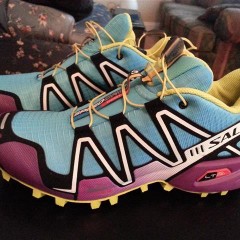
Salomon Speedcross 3 Trailrunner Review
Bottom Line: These runners were extremely comfortable right out of the box. I didn’t encounter the usual “breaking in” period that I have experienced with other running shoes. They are a fairly lightweight trail runner with a burly cleated tread which is great for technical trails and all-weather conditions. I have found that the tread wears out fairly quickly on Salomon shoes, but overall they are such a comfortable trail runner that I highly recommend them. How I chose it: I had owned Salomon trails runners previously, before I was doing any serious trail running, and loved them as an all around walking/hiking shoe. I also had a few trail running friends that highly recommended the Speedcross. Observations since using it: The lacing system is excellent. Unlike traditional style laces the Kevlar Quick-Fit system works with one pull and won’t loosen. There is even a handy tongue pocket to tuck away the laces, which I personally love as it keeps things from flapping around. It is a one-time tighten before you leave the house and you are good to go for hours. When I ran my first 50km trail race last year I used the Salomon Speedcross and I didn’t have to adjust them once in the 8 hours I was out on the trails. There was no breaking in period required for these shoes. I took them out of the box and went for a run without any issues with rubbing or blisters. They are as close as feeling liking like a slipper as a trail runner could. The fit is very precise. I have narrow feet and find that once I tighten the shoe it molds nicely to my foot which makes for a secure fit, making for more confident footfalls when running on technical trail. The toe box provides enough room to not cause issues with any rubbing or pressure points, which also helps to delay the onset of black toe nails. There is an 11mm drop in this shoe, which is simply the difference between the height of the heel and the height of the toe when standing; zero is the equivalent to standing barefoot. So there is a pretty substantial drop in these shoes which is more akin to a traditional running shoe and will support people who are heel strikers. I personally mid-foot strike, but haven’t found these shoes to cause me any issues. Pros: Lacing - Excellent lacing system with tongue pocket to keep lace ends out-of-the-way. Comfort - Super comfortable from date of purchase. Fit - Secure, precise fit due to locking lacing system and the mold of the shoe. I feel...
Sierra Designs Convert 2 Tent Review
Bottom Line: A spacious yet lightweight 2 person, 4 season tent. Burly fabric, vents well. I’d recommend it. There are some design elements that I don’t personally like, but can live with. Modular in design. If drawing an analogy with a blade it would be more of a multi-tool than a simple full tang knife. How I chose it: What I was looking for was a single walled tent, burly enough to be used in a snowstorm on an exposed ridge crest but also capable of being used through the shoulder seasons and sometimes in the summer. Liveable, but not so large that creating a platform for it would take a long time. I also wanted it to be light, <5lbs at least. After doing some extensive research into 4 Season tents (This spreadsheet of tents proved invaluable although it isn’t exhaustive so I’d still do some additional research), I settled on a shortlist of 3 tents. Black Diamond: Eldorado Mountain Hardwear: Direkt 2 Sierra Designs Convert 2-Person Tent The Eldorado is a bomber tent, and was a serious contender. But, it’s expensive, it doesn’t come with a vestibule (you have to buy it separately) and, even though it has more total real estate inside compared to the Convert II it didn’t have the extra space where I wanted it. The Convert II has 2 inches of extra headroom over the Eldorado and it’s 3 inches wider, which reduces the possibility of touching the sides which will get wet from condensation in a single wall tent. The Direkt II is the Ueli Steck tent, so it had that going for it. I quickly decided against it though. It’s amazingly light, with a packed weight of 2 lb. 15 oz, but I wouldn’t consider it a true 4 season tent. It’s a pure high Alpine Mountaineering tent, or Winter tent. There is no mesh on the entrance so I don’t know how liveable it would be during the shoulder seasons or bug seasons. It’s also small. It was designed with Ueli in mind and he’s a small guy, but I just couldn’t imagine squeezing two average sized people into it. It is 4 inches shorter than the Convert II and a whopping 9 inches narrower, ouch! Dimension Comparison Length (in)Width (in)Height (in) Convert 2855445 Bibler Eldorado 875143 Direkt 2814545 Using the top vents to look out Showing the size of the entrance Fully set up with guy lines Interior with all vents open Room enough for two with some wiggle room Here are some reasons why I decided upon the Convert II. It had the right mix of light weight...
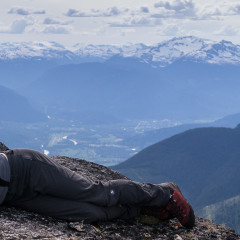
Tszil Mountain & Mount Taylor: Photo Essay
“Halo, Halo! At a place called Vertigo!” It seemed apropos that being a U2 fan (comment if you got the reference), being high in the mountains and being completely awestruck by the Sun Halo above me that that variation on those lyrics would come into my head as we ascended an airy, narrow moraine to gain a col. between Tszil Mountain and Mount Taylor. Myself, Spring and Ben had plans to explore some peaks in Joffre Lakes Provincial Park and did just that. If conditions were in we planned to also visit Slalok Mountain as well. Ultimately we ascended only the peaks mentioned in the title of this post but will be back to visit Slalok Mountain under drier conditions. This Park is justifiable so. It’s simply amazing and photos and words cannot do it enough justice. However, if I had to choose, photos do a better job than words in my opinion so I’ll let them do the talking. Have you been to Joffre Lakes? Which picture below is your...
Athelney Pass: The Park that never was
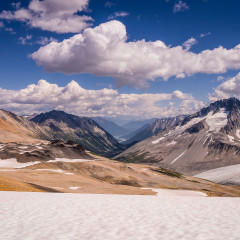
“Why isn’t this place a park?” I uttered those words as myself and Spring had just found a large rock that would be comfortable to sit on as we unpacked our lunches. We where sitting atop “The Elephant”, an unofficially named volcanic plug of rotten rock. A few kilometers away we could just about hear the whoops! of elation as 4 of our friends were reaching the summit of Ochre Mountain. We shouted out to them, not sure if they could hear us, and settled in to spend a few minutes soaking in the views before heading on to our next peak of the day. “Athelney Pass” I said to myself “… what a place!” The previous day myself, Spring and 5 other friends had spent 8 hours with heavy packs on our backs hauling our camping gear 15km’s up Salal Creek. For the most part you can walk on river rocks to follow the course of the creek, at other times you need to deke into the forest to avoid where the creek abuts the shore. It had been a hard approach hike. On paper it looks relatively easy by our standards with only 800m’s of elevation being gained over those 15km’s. We’d previously camped on Panorama Ridge in Garibaldi Provincial Park which was a 15km hike one way but with double that elevation gain and we had found that to be a breeze. This approach hike was a different kind of hard though. It was mentally fatiguing. On most trails we can just turn our brains to autopilot, but for walking on these polished river rocks we had to always be vigilant in our foot placements. Stepping on the wrong rock could mean a rolled ankle or worse. We could never really let our minds rest, we had to always be paying attention about our next foot placements. We eventually reached our campsite, beside a dilapidated mining cabin, and pitched our tents. The valley had lost the sun by the time we finally arrived and the mosquitoes had come out in their droves to feed. Nevertheless, we couldn’t help but feel like we’d arrived somewhere special. We looked out towards the large Ethelweard Glacier across from us, and turned in for the night. The next morning a few different objectives for the day were discussed. Myself and Springs plans didn’t really match up with anyone elses so just the two of us set out together. Everyone had decided to stay on the West side of Athelney Pass. The peaks on the East side of the Pass look considerably more intense and would likely require glacier travel gear....


