
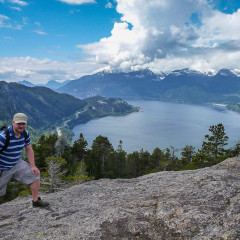
Acorns, Part 3: The Stawamus Chief
<Acorns, Part 2: Starvation Lake “The Chief” is a large dome of granite that overlooks the main core of Squamish (official name: Stawamus Chief Mountain). If you’ve been through Squamish you’ve seen it. When we started meeting people in Squamish for the first time and told them we were getting into hiking almost everybody asked us “have you hiked the Chief?”. We did some research and found out it was a steep hike up the backside of of this granite dome which eventually leads to some scrambling and walking up granite slabs before reaching the most popular summit, the South one. People generally rated it as difficult and, I’m not going to lie, we were pretty apprehensive about attempting it at first. It was going to be the first summit that we’d hike to the top of in Canada. At that time we still didn’t really understand how elevation gain would affect the difficulty of a hike. We put it off for a while, convincing ourselves that we weren’t ready yet. We began to hear more horror stories from people who’d slipped on the wet rocks or had pushed themselves to the point of throwing up due to how steep and sustained it was. It all just added to the notoriety of it. Eventually, cautiously, we decided to attempt it. This was back in 2010 and the Chief wasn’t near as popular back then as it is today. Today the trail has been vastly improved. Wooden staircases have been installed for the lower scrambly sections and the trail has been rerouted higher up to avoid difficult wet sections. Back then you couldn’t actually just start hiking the trail, it started with a section of rock that you had to scramble up to access the trailhead, beside a large sign that read “This is not a walk in the park”. We scrambled up these boulders and began heading up. Within a few meters the quads on my legs were burning with a searing pain and I could feel my heart working overtime in my chest. Every 5 minutes I had to stop from the pain in my legs and to catch my breath. My face was turning various shades of red and purple. This is what dying feels like Boulders, before we knew climbing them was a thing I remember that first ascent taking a long time. In reality it took us about 2 hours to get to the top but our progress was excruciatingly slow. Spring was definitely more capable than I was at that point so she waited patiently as I stopped every few feet to rest. About...
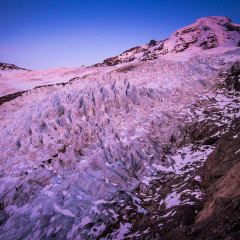
Mount Baker: Ice Climbing
“Did you see the BCMC call out for a trip to the Mt Baker seracs to do some ice climbing? Do you want to sign up?” This was the question I received in a text from Leigh one morning in October. I texted back within seconds saying “Anniversary at Baker!” It just so happened that the Thursday before the trip we would see our 8th year wedding anniversary come and go. This seemed like the perfect way to see in another year of adventure together. We signed up for the trip and started dreaming about climbing ice again. The only type of ice that Leigh and I have climbed before has been waterfall ice, some in the Rockies and some in the Coastal Range, so climbing glacier ice was going to be a new experience for us and it was going to take some time to knock the rust off of our recently acquired ice climbing skills. We set up top-ropes at the first wall of ice we could walk up to on the glacier. These first climbs proved to be more difficult than anticipated, and everyone, albeit 1 or 2, had to shout “take” more than once on their way up. There were several bulges and overhangs to contend with and the density of this ice was proving to be very hard and made for some very ginger tool placements, as no crampon or ice pick was really sinking in. All part of the learning process and also part of the beauty of ice climbing, no two walls of ice are ever the same. Once we had our fill of these climbs we decided to make our way over to an area where 2 from our group set up a few more ropes. We had to weave around gaping crevasses, jump over cracks in the ice and down-climb some sections just to get to the climbing area. It was unnerving but so much fun at the same time. It was really starting to feel like we were on another planet with such an other-worldly almost eery feeling. The only sounds apart from the odd shout of “on belay” or “climb on” was the groaning and cracking of the glacier. I walked the final narrow ice bridge towards the crevasse where the top-ropes were set up to see that you had to rappel into the hole if you wanted to climb. I felt a reluctance at first, as my first instinct is to always avoid being inside a crevasse, but I had to find a way to push through it and I joined Leigh and our friend Scott down below. Did someone say...
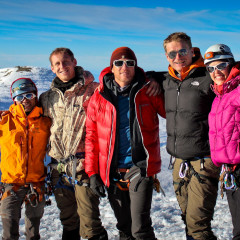
Mt. Rainier
The highest point I had been too before I attempted Mt.Rainier was the summit of Wedge Mountain at 2892m’s, in Garibaldi Provincial Park, B.C., and I remember feeling a keen sense of achievement at having scaled that height. Just knowing that it was the highest summit in the park made it feel like more of an achievement for me, like I had conquered some invisible force, a force that as you reach higher becomes more and more oppressive. Rainier, which stands at just over 4300m’s (14,411ft), was now going to be the tallest mountain I had climbed to date. Despite the many mountaineering trips I had taken in the last few years, the trip to Mt. Rainier felt like something outside of the scope of anything I had known. This was a big mountain and it felt like it deserved a deep respect of it’s own. “….the most luxuriant and the most extravagantly beautiful of all the alpine gardens I ever beheld in all my mountain-top wanderings.” - John Muir As I stood at the Paradise visitor centre looking up at Mt. Rainier on that hot August afternoon, I couldn’t help thinking of how close it seemed. It looked no farther than a stone’s throw away. Rainier just stood there in all it’s glory, streaks of grey rock showing through the late summer snow, deep crevasses gouging the glacier that tumbled down within my view, brightly colored wild flowers dotting the grassy meadows in the foreground. Standing alone in all it’s immensity with no concern for the tiny creatures standing below looking on in awe; standing there thinking that we could somehow conquer this mass of stone and ice. But as usual the mountain doesn’t care that we are there or that we care to struggle and gasp our way up it’s flanks. It is just there, and it was in my own mind that I felt this sense of the mountains willingness to accept us, allowing us to pass and giving me the opportunity to test myself. I remember looking at the winding path that made it’s way in the direction of Camp Muir, comparing it to previous hikes in my mind, thinking it wouldn’t take long at all. The mountain after all looked so close, like a super-imposed image on a screen, but no matter how long I walked that image remained the same distance away. My sense of scale was becoming more and more obscured. At that moment I remembered a quote I had seen in an outdoor store earlier that year regarding the Himalaya, it said “everything is so much bigger and so much farther away than you can imagine”....


