
Athelney Pass: The Park that never was
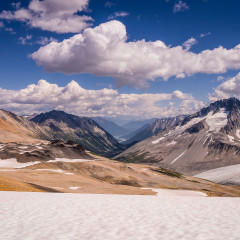
“Why isn’t this place a park?” I uttered those words as myself and Spring had just found a large rock that would be comfortable to sit on as we unpacked our lunches. We where sitting atop “The Elephant”, an unofficially named volcanic plug of rotten rock. A few kilometers away we could just about hear the whoops! of elation as 4 of our friends were reaching the summit of Ochre Mountain. We shouted out to them, not sure if they could hear us, and settled in to spend a few minutes soaking in the views before heading on to our next peak of the day. “Athelney Pass” I said to myself “… what a place!” The previous day myself, Spring and 5 other friends had spent 8 hours with heavy packs on our backs hauling our camping gear 15km’s up Salal Creek. For the most part you can walk on river rocks to follow the course of the creek, at other times you need to deke into the forest to avoid where the creek abuts the shore. It had been a hard approach hike. On paper it looks relatively easy by our standards with only 800m’s of elevation being gained over those 15km’s. We’d previously camped on Panorama Ridge in Garibaldi Provincial Park which was a 15km hike one way but with double that elevation gain and we had found that to be a breeze. This approach hike was a different kind of hard though. It was mentally fatiguing. On most trails we can just turn our brains to autopilot, but for walking on these polished river rocks we had to always be vigilant in our foot placements. Stepping on the wrong rock could mean a rolled ankle or worse. We could never really let our minds rest, we had to always be paying attention about our next foot placements. We eventually reached our campsite, beside a dilapidated mining cabin, and pitched our tents. The valley had lost the sun by the time we finally arrived and the mosquitoes had come out in their droves to feed. Nevertheless, we couldn’t help but feel like we’d arrived somewhere special. We looked out towards the large Ethelweard Glacier across from us, and turned in for the night. The next morning a few different objectives for the day were discussed. Myself and Springs plans didn’t really match up with anyone elses so just the two of us set out together. Everyone had decided to stay on the West side of Athelney Pass. The peaks on the East side of the Pass look considerably more intense and would likely require glacier travel gear....
Welch Peak: Photo Essay
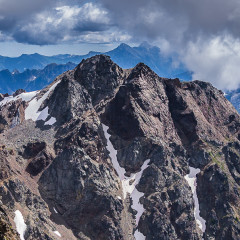
On the last Saturday in July, 2013 myself and Spring and two other likely companions, Ben and Cody, reached the summit of Welch Peak in the Cheam Range of British Columbia. The scrambling is airy and exposed but fun. There is just enough solid rock to scramble on to make you forget the crumbling piles of choss or as I decided to call them “death skittles” which is all the loose sand and pebbles atop otherwise good rock (definitely inspired by the fact I was munching on actual Skittles all day). On the Friday night we decided to camp on an old Forestry Road near the trailhead. This proved to be the mental crux of the trip. An overactive imagination and past negative experiences leaving a vehicle overnight in the vicinity coupled with having to camp at a pullout littered with shotgun shells, broken glass and shrapnel embedded trees made for a somewhat restless nights sleep. The next day we reached the summit of Welch Peak. It was a long day, with moments of sheer bliss, pupil dilating terror, brow furrowing frustration and pure comradery in the face of tribulation. At times it felt like we were struggling and wrestling against the mountain but ultimately, as we departed from the summit, and toasted stream chilled Ale back at the trailhead, we felt that the mountain had given us far more on that day than it ever could have taken from...
“Great photos aren’t taken, they’re made”
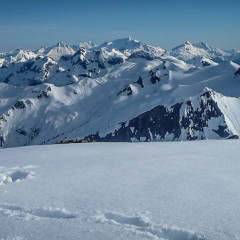
I’ve seen the title of this post, a quote from Ansel Adams, come up a few times when reading about modern photography and it generally holds negative connotations as people assume it refers to excessive post processing and “photoshopping” to change the results in the image. This is not what Ansel was referring to. He was referring to the difference in the eye of someone who is, or hopes to be, a Photographer and an individual who is simply taking a snapshot. Beauty can be seen in all things, seeing and composing the beauty is what separates the snapshot from the photograph. - Matt Hardy For the most part, I’d safely define the vast majority of individuals who own cameras as amateur Photo Journalists, in that they wish to journal the events and moments they experience so they use a camera to effectively do this. A turning point happens when you stop trying to catalog events as they happen and wish to create an artistic representation of what you are seeing. When you start to become an Artistic Photographer. When you stop merely taking a photograph of a scene and start making the photograph before you close the shutter. Don’t shoot what it looks like. Shoot what it feels like - David Alan Harvey For me this has been a gradual process. I largely started out wanting to journal my experiences as they happened. Comparing my folders of digital images now I’m not really taking more images today than I was a few years ago but what I’m photographing has changed immensely. Going back a few years I can see that I would take photos as I moved, usually at eye height and directly at what I was looking at. I’d usually take one photo per view and move on. Now, I’m taking a similar number of photos but the content has been vastly reduced. I’m taking many pictures of a single moment, from different angles and heights, with different apertures, ISO’s and shutter speeds. The gap in time between my photos is no longer documented as I’m not concerned with simply journaling my experience but rather creating my own personal artistic representation of the experience. The difference between “Taking” and “Making” a photo you’d print and hang on your wall is subtle but the results can vary immensely. Making a photo could be as simple as dropping to one knee and using a different aperture rather than taking the photo from a standing height and using the auto setting on the camera. I don’t imagine that I’m an amazing photographer myself, but I make photos that I personally...
Ice Climbing, Canmore
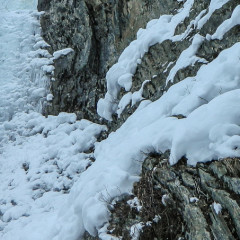
Swing like you screw, kick like you poo. “I don’t screw like that” a girl replied cheekily from the back row of our Ice Climbing group. Our instructor, Carl, paused a moment, cracked a wry smile in response and moved on: “When you swing your Ice Tools get your hips in against the ice, legs extended and shoulders out, like you screw. When you want to kick, hang off your highest tool and get your butt out, like you’re going to poo and look at where you want your feet to go” We were on our second day of Ice Climbing instruction with Yamnuska Mountain Adventures near Canmore, Alberta. The previous day they’d given us an intro to Ice Climbing at the climbs Irish Mist and The Water Hole, today we were at Kings Creek to hone our technique further on some single pitch Ice. The snow gods had finally answered the pleas from Skiers all over the Rockies and on this day it was dumping snow after a rather long drought in these parts. Anything we put down on the ground for a few moments was soon buried under fluffy white powder. I imagined it might make for a rather miserable day of climbing Ice but it turned out to be one of the best. Kings Creek lies at the bottom of a gorge with steep rock walls on either side. As snow built up above eventually it would fall off branches, boulders and slopes when they could no longer hold the weight of it. It would cascade down, get funneled into gullies, gain speed, bring other loose snow with it and eventually reach the bottom where we were climbing. This made for an almost ethereal experience while climbing ice, which isn’t exactly the most normal activity to begin with. Snow cover Belaying in Kings Creek Kings Creek Climb As we climbed, periodically, these sluffs of snow would hit us in waves. It was like being suddenly shaken up inside a snow globe. You could only brace against the ice and hope your belayer hadn’t been buried below. As I finished climbing another line and shouted “Take!” to my belayer, I clipped my ice tools into my harness and lowered my hands to my sides. My hands started to ache, ache badly (In ice climbing this is affectionately known as the Hot Aches or the Screaming Barfies). I braced against the pain and resolved to stop over gripping my Ice Tools next time. I looked down and shouted “Lower” to my belayer. At that moment I could see a snow sluff from my vantage point picking up mass and momentum above and barrelling down....
We are human beings, not human doings..so just be
The first time I heard this phrase was in one of the first Yoga classes that I’ve attended. At the time, when I heard it I giggled to myself thinking it sounded a little silly and maybe a little airy fairy. I’m sure at the time the Yoga teacher was just saying this to get everyone to relax, “be” in the moment and just breathe. But when I really think about what this combination of words is trying to say, it really hits home for me. I tend to be the type of person who takes things to heart, internalizes my feelings and then ends up feeling a lot of stress. But what am I doing? Why am I allowing myself to do this? I am the only one who can control what is happening in my mind and how I choose to accept external influence or opinions. Come on…… take a deep breath and just….. be. Just allow life to roll over you and through you, feel it, taste it; the good and the bad. Allow life to be the adventure it should be and allow it to shape you. Don’t fight so hard against its current, it’s going to ebb and flow and the more relaxed and more willing you are to face it straight on, the easier it will be to flow with it, rather than try to break through each wave as it comes at you. I guess that’s the funny thing about life. It’s so much bigger than ourselves that it feels like it should be something that needs to be in our control, like we should always have a tight grasp on what is about to happen next, to avoid feeling fear, disappointment, betrayal, all the truly uncomfortable human emotions. But if we didn’t feel the fear would we still feel exhilaration? If we didn’t know betrayal would we truly understand trust? We don’t need to seek out these uncomfortable emotions, but I don’t think we should run away at the first sight of them. Allow yourself to rise up to meet them. See how you transform in response to them; allow yourself to feel them so that they can refine you and let you know what is truly worth holding onto and what is worth discarding. Like any truly great adventure, life has transformative powers if we give ourselves over to it....


